Just over a month ago, after the holiday of Simchat Torah, we finished our yearly cycle of reading the Torah and started anew. The first parasha, "Bereishit" (literally "In the Beginning", often translated as "Genesis"), recounts creation. The levels of depth in these lines are infinite.
This year, one particular concept was brought to my attention. About (almost) each thing created, it says, "Let there be...", "And there was...", and "It was good."
In his new book, "Covenant and Conversation," Rabbi Jonathan Sacks (Chief Rabbi of the UK), wrote a beautiful explanation of this concept. Whenever I include quotes in my explanation and application of this concept, it is from his book.
On a fundamental level, this account of Creation lays the groundwork for a Jewish approach to life. Life and the world are seen as inherently Good.
This begs the question, "If everything was created Good, how do people become evil?" Rabbi Sacks claims, "Their tragedy was that often they came from dysfunctional families in difficult conditions. No one took the time to care for them, support them ... They lacked a basic self-respect, a sense of their own worth. No one ever told them that they were good." This description refers to extreme cases, such as criminal offenders.
So if ignoring the good in an individual makes one being evil, how can we make people great?
By acknowledging the good in them.
"To see someone is good and to say so is a creative act - one of the great creative acts. ... Within almost all of us is something positive and unique, but which is all too easily injured, and which only grows when exposed to the sunlight of someone else's recognition and praise. To see the good in others and let them see themselves in the mirror of our regard is to help someone grow to become the best they can be. 'Greater,' says the Talmud, 'is one who causes others to do good than one who does good himself.' To help others become what they can be is to give birth to creativity in someone else's soul. This is done not by criticism or negativity but by searching out the good in others, and helping them see it, recognize it, own it, and live it." ... "When we recognize the goodness in someone, we do more than create it, we help it to become creative. This is what G-d does for us, and what He calls us to do for others."
I think this is a very powerful message for parenting. So often, parents feel an urge to criticize the things their child does wrong. Whether it's something simple, "You put your shirt on backwards again." Or something more damaging. Think of how good our children would feel if we acknowledged the good in everything they do. Recognize the positive effort, "Wow, you put your shirt on all by yourself! Can I help you turn it around the right way?"
I can only imagine the potential for this strategy as children get older. When children have hobbies and talents that begin to develop, a parent cheer leader and advocate (in a healthy way of course) can make the child truly feel GOOD.
Beyond parenting, this concept can be applied to all relationships in life. With parents and friends, it is not only important to see the good in them, but to tell them that you recognize it. By pointing out a good quality, it brings it to their attention. On one hand, it makes them feel good. Further, sometimes your acknowledgement of their strength causes them to feel a healthy sense of pride and exude that strength to a greater extent. You therefore make a contribution to the good they bring into the world. This is just about as close as we can get in this world to emulating Divine Creation.
Wednesday, November 21, 2012

Instilling Gratitude
Adina is finally reaching an age where she can make positive contributions to projects that we do together. Not only is she getting better with coloring, cutting, and gluing, but I see a blossoming in her ideas as well.
This week, I decided to do a Thanksgiving project with her. She doesn't really get the connection of the turkey animal to the turkey we eat yet, and I thought this whole concept would confuse her a bit. So instead, I decided to do a "Thankful Project." For the past week, at random points throughout the day, I would tell her something I was thankful for and ask her to do this as well. While I have taught her to say, "Thank you," when given something, we had never before discussed the feeling of gratitude.
Yesterday, for our morning activity, we made an "Adina Tree" and a "Mommy Tree" by tracing our hands and arms. Then, while Adina colored the "sunshine" all around the trees, I cut out leaves. (She could relate to this project because she has been very into noticing the changing colors of the leaves and pointing out whether trees still have leaves or if they've lost them all already). Before she glued each leaf on her tree, I asked her to tell me one thing she is thankful for. It was slow going at first, but then she kept saying so many more that I needed to add "stickers" to her finger because we were out of leaves.
At first, I thought he was asking questions to try to figure out if there was a reason for my not so cheerful mood. Then I realized he was giving me perspective. Yes, there were a couple of things to complain about. But look at all of the things to be thankful for! Just a few hours before, I had sat down with Adina discussing how many things we should be thankful for, and here she sees me telling Aba all the negatives.
This week, I decided to do a Thanksgiving project with her. She doesn't really get the connection of the turkey animal to the turkey we eat yet, and I thought this whole concept would confuse her a bit. So instead, I decided to do a "Thankful Project." For the past week, at random points throughout the day, I would tell her something I was thankful for and ask her to do this as well. While I have taught her to say, "Thank you," when given something, we had never before discussed the feeling of gratitude.

Now this project is all well and good, but the lesson for Mommy came later in the day.
Nap time didn't go quite as planned. I felt tired. The house was a mess and getting messier.
Yoni came home right in the middle of it.
Cheerfully, he asked, "How was your day sweetie?"
Poor guy. I started in on my laundry list of complaints.
Yoni calmly sat down and said to me, "Do you feel ok?"
"Yes," I responded.
"And the kids are healthy?" He asked.
"Yes, they are."
"Did you eat a good lunch and breakfast today?"
At first, I thought he was asking questions to try to figure out if there was a reason for my not so cheerful mood. Then I realized he was giving me perspective. Yes, there were a couple of things to complain about. But look at all of the things to be thankful for! Just a few hours before, I had sat down with Adina discussing how many things we should be thankful for, and here she sees me telling Aba all the negatives.
It seems as though the best way to teach children gratitude is to constantly dwell on things we are grateful for ourselves. Making thankful trees for art projects are fun, but I need to internalize the concept so that I can impart it on my kids. Lesson learned. :)
Sunday, November 4, 2012
A parent-child relationship: Mutual respect
Parents have a lot of responsibilities when it comes to child-rearing!
Yes, there are the responsibilities to feed, clothe, provide shelter, etc. to your children. Those are the easy ones. The hard ones don't come with such black and white, yes or no guidelines.
One particular responsibility that I have been thinking about a lot the past couple of days is teaching children what it is to respect. First and foremost, this begins with respecting their parents. Once that is mastered, this education extends to other adults, their friends, and everyone in the world around them.
Since it is very well-known that children do not learn from lectures, giving over a dissertation on the process of respect would be completely meaningless. How can one impart this very important lesson to their children?
Yesterday, as I thought about this concept, it all came together. Children are sponges, right? So the most important contribution to their lessons in respect must be observing respectful interactions. Yes, this of course means watching their parents treat others with respect. But arguably more important it means being treated with respect themselves. Not only does this serve to model how one acts respectably, but it also shows them how good it feels to be respected (on the receiving end). As much as people deny it, on a deep level children ultimately want to make their parents feel good. If they know how good it feels to be respected then they will treat their parents (and eventually others) in that same way.
So how do we treat children with respect?
It starts from infancy. The Baby Whisperer is very big on respect for infants. When you change a baby's diaper, talk through what you are going to do in the process. Show respect for the fact that you are throwing a baby onto a table, spreading his/her legs and making their wet tushie cold by taking the diaper off. Say, "I know this isn't so pleasant, but it's important to do so I can put a new, clean diaper on you and then you will be happy."
No matter how you decide to teach your child good sleeping habits, do it in a respectful way. While I am not necessarily of the "Cry it out" camp, I understand the rationale of those who are. If you believe in letting your baby cry, this might sound silly, but discuss it first. Show them the respect of acknowledging that they are a person with emotions that is about to undergo a difficult experience. Say, "It is very important that you learn how to sleep well. I have decided to let you stay in your crib until you fall asleep. I know this is difficult, and I want you to know that I love you very much, but I won't come back in the room until you wake up." Whether the child understands what you are saying or not, you are setting the tone for a lifelong relationship of mutual respect.
Into toddlerhood, this gets a lot more complicated because it becomes a two-way conversation. If I want Adina to use "manner words" when she makes requests of me, I must do the same when I make requests of her. If I want her to listen to me and do what I say, I must respect her when she asks me to do things. This does not mean I must curtail to her every beck and call. If she says, "Mommy, can I please eat five cupcakes right now?" I am not going to say, "Of course sweetie." But I am not going to respond with a harsh, "No!" either. I will respectfully decline her request. I might say, "I know those cupcakes look really good, but I don't think it is a good idea to eat five of them. Maybe you can have one right now and we will save another one for a special treat on Shabbat."
If this is the kind of modeling behavior she observes, then I can only hope that when I say, "Adina, can you please do...." she will respond respectfully. She might respond affirmatively, or she might say, "Mommy, I don't want to do that right now" and open the grounds for a respectful conversation. Since she is still 2, I will of course receive the occasional, "NO!" but I can only hope this decreases as she gets older. I know a few moms who are experts at imbibing their children with respect, and thank G-d, their elementary aged children are some of the most respectful people, let alone children, that I know. I can only hope I will be able to do half as good of a job in teaching respect to my own children.
A few other thoughts on internalizing a respect for your children...
About six months ago, I made a resolution to not speak negatively about Adina in her presence. It is very common during play dates or get togethers for the Moms to discuss their child's behavior within earshot of the child. While the child might be playing, their ears are still open. I still find myself doing this sometimes, but I am working really hard to stop it. The truth is, I ultimately want to avoid sharing negative components of my children's behavior at all with other people, unless it is with my husband or a close friend and for a constructive purpose.
In Judaism, there is a concept of Lashon Hara. This literally means, "Bad language," but it refers to using your words for an unnecessary or negative purpose. Speaking Lashon Hara is forbidden in Jewish Law. Most often, people view this Law as an instruction to refrain from gossip, but people rarely consider it gossip if they are speaking about their own children. But the truth is, children also feel embarassment. Children also feel shame. If children feel embarrassed at the hand of their own parent, the one who is supposed to love and protect them more than anyone in the world, it undermines any feeling they could have of being respected by their parent.
L'havdil (in a very different, but similar vein...)
Some of my clarity on this topic came about through experiences we had with Libby this week. The past few months, Libby has become a progressively more difficult dog. She was becoming very anxious. Every time we left the house, she barked uncontrollably. Multiple nights a week, she would bark and wake us up at 3 AM. I don't have any young babies at home right now, and being awake from 3-5 AM with a dog was not so much fun. I was at wits' end and on the verge of finding her a new home...
Then Yoni's parents came to visit for a long weekend. Libby slept next to their bed (and in the bed whenever Yoni's Dad had to leave the room for a few minutes...) and during those few days, her anxiety nearly disappeared. She sat quietly at the door and watched us leave time and again without a peep.
So after they left, and we really acknowledged the stark contrast in Libby's behavior, Yoni reluctantly made a suggestion. He asked, "Can Libby sleep in our room?" I have been resisting this for a very long time from the negative experiences I had during our transition to Seattle. When we lived in a small "Temporary Living Facility" in Altus, Oklahoma for a few months, I was very pregnant (with Ze'ev), sleeping on a pull out couch and Libby had to be in the room with us. Libby was anxious from all the transitions and woke us up multiple times a night. But what could be worse than her barking now? So I agreed to try it. She has been the happiest doggy I have ever seen this week. She sleeps quietly on our floor all night and is perfectly fine every time we leave the house during the day. She is even significantly calmer with guests because she is not craving love and attention. The truth is, we are not even actively giving her much more love, but simply sleeping in close proximity to her "masters" makes her feel loved and secure.
This is not meant to be an endorsement of co-sleeping, but simply an observation. For months, I tried to teach her how I wanted her to behave with force. Every time she barked, I got in her face and said, "NO BARK!" She didn't want to bark, but her emotions were out of control from not feeling loved and it was her only outlet. Now, she is so happy to finally feel in control of herself since the anxiety has subsided. She is so happy to please us by obeying our commands. All she needed was to feel loved and respected.
The good thing with Libby is that dogs have very poor, short-term memories. She now acts as if we've treated her like this her whole life and never left her to sleep alone. Children can be slightly less forgiving. But resolve and persistence can go a long way.
My new hobby...
A few friends have asked me recently why I haven't been writing as much the past month or so. While I have had lots of creative juices flowing, I have actually been using a few other outlets. First of all, I have been doing a lot more writing in my personal journal, which had kind of taken side line since I started blogging. I have also started a new kind of art that I am just beginning to experiment with. This first drawing I made for Yoni for his promotion to Captain. I used pencil and water color marker to draw the C-17 and then wrote Tehillim 121 (Psalm 121) around it in Hebrew and English. Pardon the glare from the flash of the camera...I probably should have turned the flash off, but this will do...

Then I made another fun project. I just did this one last week and I already see a few parts that I want to fix up a bit, but here's a picture of the first draft. I used pastels which I have never used as a medium for art before, so I am just learning. The Hebrew is the blessings you say after eating food, so I drew foods all around. If I do an updated drawing in the next few weeks, I will try to remember to post a picture. I purposely put the pastels on a separate paper from the Hebrew I wrote so that I can redo one while keeping the other. I hung this on the wall in our eating area as an encouragement to keep with my attempts this year at always remembering to say the blessing when I finish eating.

Tuesday, October 23, 2012
Photos help remind me where the days go...
The past few weeks (months?) have been a bit of a whirlwind, but we are slowly settling into a bit of a routine. As I mentioned before, Yoni returned from his deployment the first day of Sukkot. The holiday lasts 8 days (days filled with synagogue, food, and moving back home from the Air Force Base). The very next day, Yoni returned to work and found out that the following morning at 5 AM he had to leave for a trip. Now this trip was only a week away, so compared to the deployment it feels like nothing, but it kind of took me by surprise because I didn't feel like we had a moment to take a step back and relax together at all since his return. But no rest for the weary - on that Thursday morning, he was off!
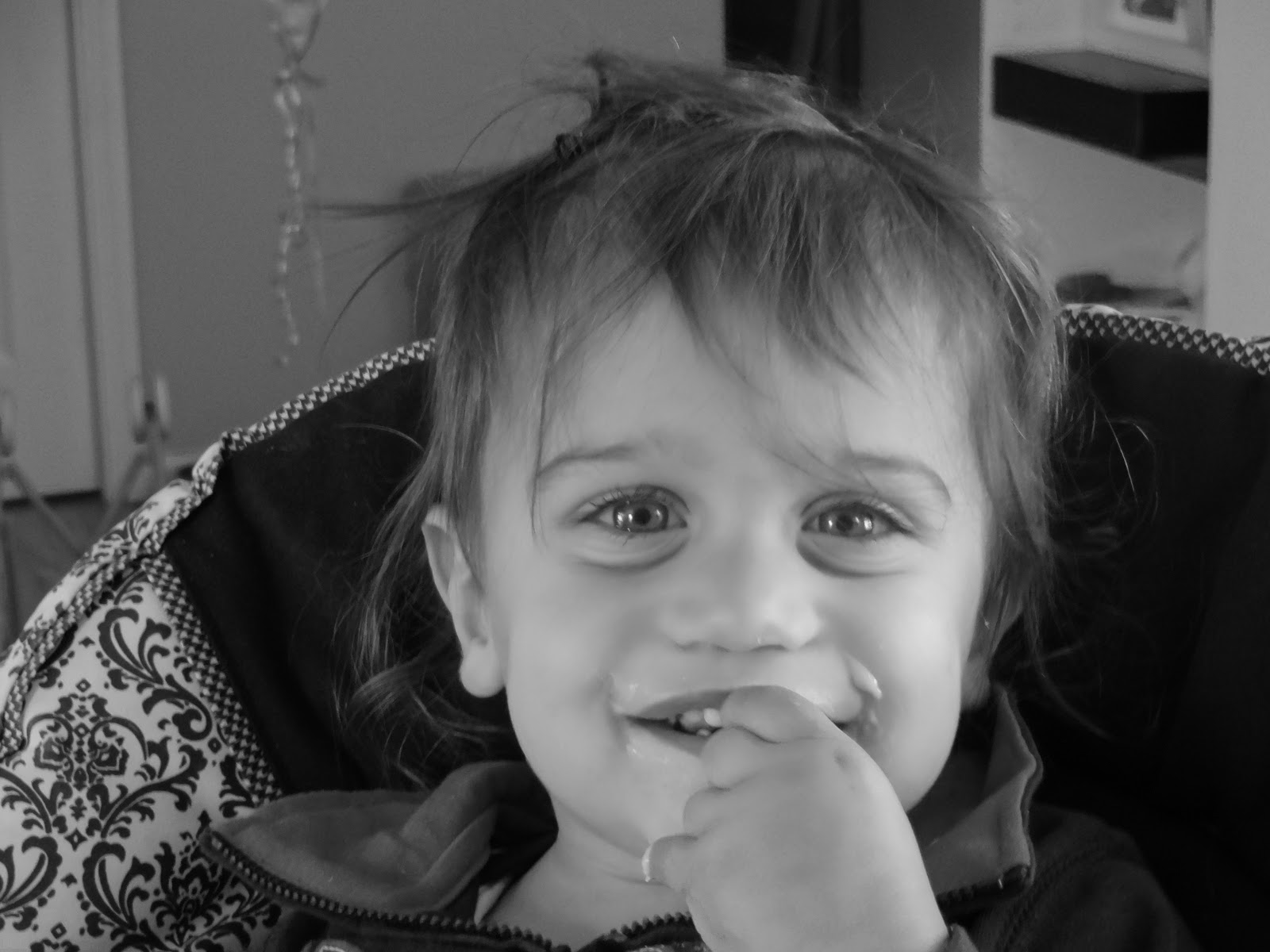
During his time away, I had a lot of fun with my new camera I got for my birthday from my parents (Thanks! :) ) Here are some black and white head shots of the kids sitting at the table during lunch time:

And a color shot of Ze'ev enjoying his yogurt...

Looking at these pictures again now, I want to share how much these smiling little faces get me through day after day when Yoni is away. I absolutely love spending my days with them. Yes, it is a lot of work! Yes, I get very tired! But I can't imagine doing anything else with my life... I can't imagine anything else bringing me more joy or giving me more fulfillment than raising these two beautiful souls...
The timing actually worked out quite perfectly for me, because just a couple days after Yoni left, my parents arrived for a short visit. They were disappointed that they missed seeing him again, but at least I had company for the majority of his absence. Here are some pictures during their time here:


And a black and white shot of story time with Poppy...

Here's another fun photo I took of Adina at the park...

And now, back to life as "normal."
 |
| Just hanging out reading a book |
 |
| Ze'ev's new shirt celebrating Aba's promotion to Captain during his deployment |
 |
| A cute picture of Adina hugging her good friend during one of their many play dates |
Wednesday, October 3, 2012
Our temporary dwelling...
After many attempts at getting special religious accommodations and many discussions with his commander and chaplains, Yoni had no choice but to return home with the rest of his squadron during the first yom tov days of the holiday Sukkot (during which we observe the laws restricting driving, phone, etc.). So the kids and I packed up and headed to base so that we could walk to meet him as he got off the airplane and be there to spend the rest of the yom tov with him.
Thank G-d, all of the intense logistics worked out pretty seamlessly. I'm not even going to go into all of the details here, because it made my head spin for a week and I don't want to do that to all of you. But it could not have been done without help. Some really amazing women (other pilots' wives) from the squadron helped with the kids while I unpacked and then had to switch rooms the next day. It was also great for my kids to spend some fun time playing with their kids and for me to have some company while we eagerly anticipated Aba's return.
In some ways, I absolutely loved this arrangement. When Yoni returned, we had a little vacation. We had a day to completely relax and just spend time together as a family - almost like a mini vacation - before returning home to laundry, unpacking, and cleaning.
The biggest negative about him arriving on yom tov, in my opinion, is we were not able to take pictures of the reunion. Thankfully, one of the wives had a friend there who's a professional photographer and happened to snap one shot of Adina as we watched the airplane taxi after landing. I had the sling on to carry Ze'ev, but apparently he was off running somewhere.


Adina was very excited (contrary to her very serious look in the picture), and I knew that she would jump into Aba's arms once she saw him.
I wasn't quite sure how Ze'ev would react. In the past two months, he has developed intense separation anxiety, and has refused anyone but Mommy. I was so pleasantly surprised. Within a minute, he reached his arms out to Aba, cuddled onto his shoulder and wouldn't let go. Yoni has fed him a lot of meals and put him to sleep the past couple days, and Ze'ev is more than happy to not have Mommy around for all of those things. Not only is it a little reprieve for me, but it is so nice for Yoni to have this time to bond with him. :)
Now we have about a week home together... until he resumes flying his week-long missions. But hey, if I can handle 2 1/2 months, a week will feel like nothing!
Life as a painting... and where we stand when we view it.
Since my first year in college, when I began delving into the depth of a Jewish world view, I have combined many different explanations and analogies within my mind to understand this world and our purpose in it.
One of the first analogies I heard has always stuck with me. At each stage in our life, we are drawing a few lines and putting different splotches of color onto a canvas. Sometimes it can look pretty or seem exciting or boring, or even dreary. Only at the end of our life can we step back from the canvas to see how all of those random colors and lines blend together to form a beautiful painting.
This analogy has also helped me at different points in my life when I struggled with emuna (faith). If I believe G-d's hand is guiding the paintbrush, even those big black splotches have meaning and make a positive contribution to the painting as a whole.
Freshman year of college, on one of my first weekends back home, I tried to apply this analogy to my life with the following poem:
(written November 23, 2004)
Every place has a story.
I walk down the street and memories race.
How can so much meaning
be embedded in a place?
The world is my canvas,
but up to this time
I had only walked along
a thinly drawn line.
And along that line,
I knew it all.
Now reimmersed,
I so easily recall.
With every step I take,
I remember the feel.
My naive perceptions of life
once again seem real.
But although on some layer
that line remains,
the picture around it is forming
and its essence is changed...
Now why have I started thinking of this analogy over the past week?
I've started to look at relationships as paintings. When we're in the day to day involvements of a relationship, we see only the color splotches and lines. We see it so close up that a little splotch that's not exactly where it's supposed to be can nag at us or become bothersome. We analyze the line formations.
When you have a distance relationship for a few months, you take a few steps back from the painting. You see and appreciate the beautiful picture formed by all those little lines and splotches. Now, as Yoni has returned home, I try to keep that big picture in mind.
Subscribe to:
Posts (Atom)